
Market News
Nigeria’s Trade Surplus Hits N12.6trn in Q2 2026 on Stronger Export Earnings - PROSHARE
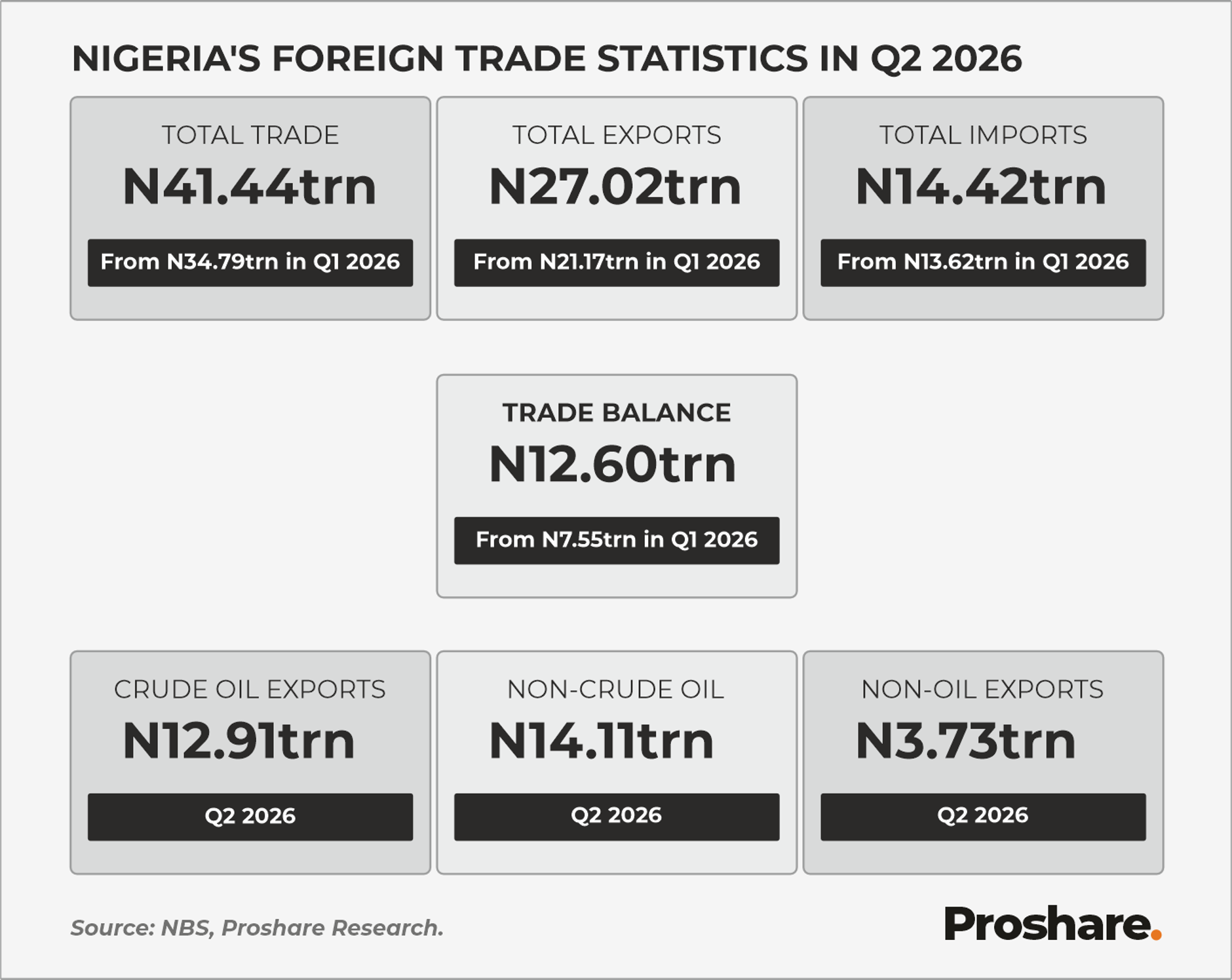
Nigeria’s external trade position strengthened materially in Q2 2026, with the merchandise trade surplus widening to N12.60trn, up 101.32% YoY and 66.85% QoQ. The improvement was driven by a 27.64% QoQ increase in exports to N27.02trn, led by stronger crude oil and other oil product receipts.
The continued decline in petroleum product imports on a year-on-year basis is encouraging, although imports rose 5.91% QoQ, reflecting increased domestic demand.
The outlook remains constructive, supported by domestic refining capacity and stronger export earnings. However, sustaining the trade surplus will depend on oil production, global prices, exchange-rate stability and progress in expanding non-oil exports and domestic productive capacity.
According to data released by the National Bureau of Statistics (NBS), Nigeria’s merchandise trade position strengthened significantly in the second quarter of 2026, as the trade surplus widened to N12.60trn, representing a 101.32% increase from the corresponding quarter of 2025 and a 66.85% rise from the N7.55trn surplus recorded in Q1 2026. The improvement was driven primarily by a strong increase in exports, which more than offset the moderate recovery in import demand during the quarter.
Total merchandise trade stood at N41.44trn in Q2 2026, representing a 5.61% increase from N39.24trn recorded in Q2 2025 and a 19.13% rise from N34.79trn in Q1 2026. Exports accounted for 65.20% of total trade, while imports accounted for 34.80%, reflecting a stronger external trade position than the preceding quarter.
Imports
The value of total imports stood at N14.42trn in Q2 2026, representing a 12.55% decline from N16.49trn in Q2 2025, but a 5.91% increase from N13.62trn recorded in Q1 2026. The quarterly increase suggests some recovery in import activity, although import values remained below their level a year earlier.
China remained Nigeria’s leading source of imports, followed by the United States of America, India, the Netherlands and Germany. The major imported commodities during the quarter included Motor Spirit Ordinary, petroleum oils and oils obtained from bituminous minerals.
Agricultural goods imports rose to N1.20trn, increasing 1.63% from N1.18trn in Q2 2025 and 45.43% from N827.72bn in Q1 2026. Similarly, raw material imports increased to N1.79trn, representing a 4.11% YoY and 13.12% QoQ increase.
Solid mineral imports declined to N56.99bn, down 19.60% year-on-year (YoY) and 18.30% quarter-on-quarter (QoQ). Meanwhile, manufactured goods imports increased substantially to N9.51trn, rising 20.65% YoY and 12.10% QoQ, indicating continued reliance on imported manufactured products.
Other oil product imports stood at N1.08trn, representing a sharp 73.08% YoY decline, although the value increased 43.71% QoQ from N748.10bn. Despite the quarterly increase, the substantial year-on-year reduction points to a continued moderation in Nigeria’s dependence on imported petroleum products.
Exports
Total exports increased to N27.02trn in Q2 2026, representing 18.77% YoY increase from N22.75trn and a 27.64% QoQ rise from N21.17trn in Q1 2026. The stronger export performance was supported by higher crude oil receipts, a significant increase in other oil product exports, and stronger raw material and solid mineral exports.
Nigeria’s leading export destinations were India, Spain, the Netherlands, the United States of America and Togo. The major exported commodities were crude oil, kerosene-type jet fuel, natural gas, urea, and other petroleum gases in gaseous form.
Agricultural exports declined to N802.99bn, representing a 36.09% YoY decrease and a 31.51% QoQ decline. In contrast, raw material exports rose sharply to N2.31trn, increasing 181.24% YoY and 50.31% QoQ, highlighting stronger external demand for Nigeria’s raw material exports during the period.
Solid mineral exports also recorded significant growth, reaching N146.91bn, up 90.03% YoY and 42.91% QoQ. Manufactured goods exports stood at N393.03bn, declining 51.10% YoY, but increasing 29.87% QoQ.
Crude oil exports increased to N12.91trn, representing a 7.93% YoY and 15.28% QoQ increase. Crude oil remained Nigeria’s largest export category, accounting for 47.79% of total exports.
Other oil product exports recorded an even stronger performance, rising to N10.38trn, representing a 34.08% YoY and 53.05% QoQ increase. The combined performance of crude oil and other oil products therefore remained the principal driver of Nigeria’s export earnings during the quarter.
Trade Balance
Nigeria’s stronger export performance significantly widened the merchandise trade surplus to N12.60trn in Q2 2026, compared with N6.26trn in Q2 2025 and N7.55trn in Q1 2026. Exports of N27.02trn exceeded imports of N14.42trn, resulting in exports contributing 65.20% of total merchandise trade during the quarter.
Crude oil remained the dominant export, valued at N12.91trn, while non-crude oil exports amounted to N14.11trn, accounting for 52.21% of total exports. Within this category, non-oil products contributed N3.73trn, equivalent to 13.80% of total exports.
Analysts’ Take
Nigeria’s external trade position is expected to remain supportive in the near term, particularly if crude oil production remains stable, global energy prices remain favourable, and domestic refining capacity continues to reduce the need for imported petroleum products.
However, the sustainability of the trade surplus will remain sensitive to crude oil prices, production levels, exchange-rate movements and domestic import demand.
For investors, the widening surplus is supportive of Nigeria’s external liquidity and foreign-exchange position, particularly as higher export receipts can strengthen the supply of foreign currency.
The outlook, however, remains dependent on whether export growth can broaden beyond hydrocarbons and whether domestic production can increasingly substitute for imported manufactured and intermediate goods.