
Market News
Why Africa’s Economic Growth Has Not Become African Prosperity - BLOOMBERG
Rhavy Nursimulu, CEO of LOGI-CONSULT
Africa’s economic transformation presents one of the most consequential questions of our time: how can the continent convert expanding economic activity into enduring productive capacity and shared prosperity?
Across African economies, investment is reshaping infrastructure, trade is connecting markets, and industrial ambitions are gaining momentum. The economic significance of these developments extends beyond the growth they generate. It lies in the productive capabilities they establish, the enterprises they strengthen and the wealth they enable societies to retain.
Through my engagements with African ports, trade corridors, industrial territories and institutions, I have become increasingly interested in what remains after economic activity has taken place. How does a growing maritime gateway contribute to the industrial economy surrounding it? How does mineral production develop domestic technical capabilities? How does investment translate into competitive enterprises, productive employment and stronger household incomes?
Advertisement
These questions bring us to the relationship between economic growth and prosperity, and to the architecture through which one becomes the foundation of the other.
Growth measures activity. Prosperity measures what endures
Gross domestic product is indispensable: it measures the value an economy produces over a given period. Its expansion can reflect stronger demand, investment and opportunity. But I am interested in a second balance sheet, less visible in the headline numbers: the skills firms acquire, the industries they can sustain, the incomes households can rely on and the value that remains available for reinvestment. These are the assets through which one period of growth can improve the next.
A mineral shipment adds to exports. A major infrastructure project raises construction activity. Higher commodity prices can strengthen public revenues. All three may be valuable. Their lasting significance depends on the productive relationships that follow: whether domestic firms become suppliers, technicians gain transferable expertise, manufacturers obtain dependable inputs and public receipts strengthen the services on which enterprise depends. The question is not simply what was produced or transported. It is what the economy becomes capable of producing next.
Our nine-country comparison brings this distinction into focus. It places 2025 real GDP per capita beside the latest available estimate of poverty below $3 a day. Mauritius and the Democratic Republic of Congo occupy very different positions. Yet the more interesting lesson lies beyond the endpoints. National output, household welfare and the institutions connecting them do not move in a mechanically uniform way. Distribution, economic structure, labour markets, public services and long histories of accumulation all shape the outcome.
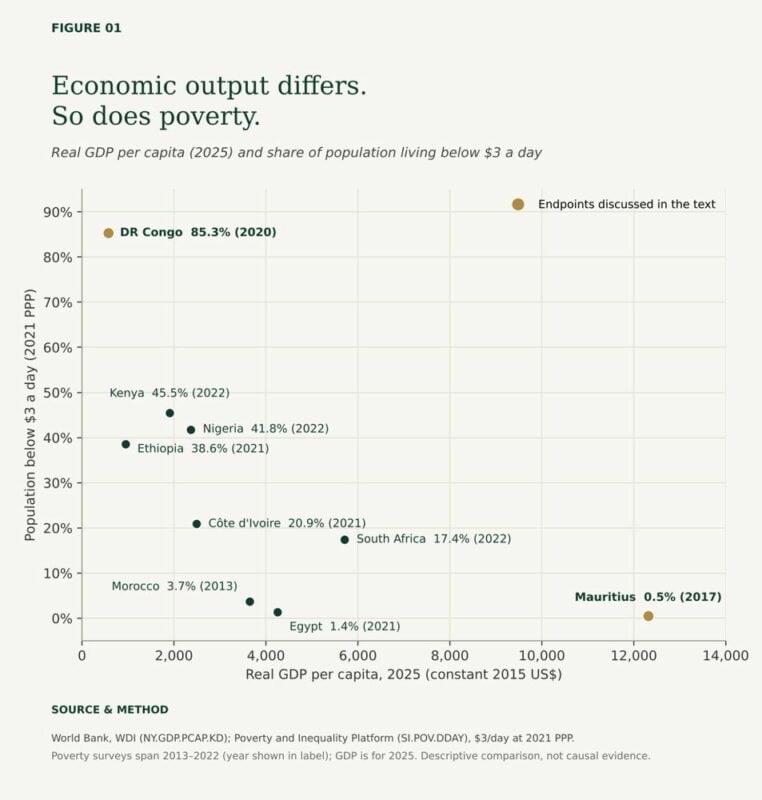
The chart is deliberately descriptive. Its poverty surveys span 2013 to 2022, whereas its GDP observations refer to 2025. It cannot measure the effect of recent growth on poverty or establish causality. What it can do is expose a question that aggregate output figures often leave unanswered: how effectively does an economy turn productive activity into household prosperity?
The decisive variable is productive capacity
For an economy, the deeper dividend of growth is the ability to produce more, and to produce better, tomorrow. That ability resides in people and enterprises, but also in the systems connecting them: engineering and managerial skills, reliable energy, affordable logistics, serviced industrial land, finance, standards and market access. Productive capacity is cumulative. Each successful investment should make the next productive undertaking more feasible, not merely add another isolated asset.
Advertisement
This is especially important in resource-rich economies. Mineral extraction can generate capital and foreign exchange; the larger opportunity is to develop geological services, maintenance, processing where commercially viable, fabrication and domestic suppliers around it. Agriculture presents a parallel opportunity. The journey from farm output to higher-value food industries depends on storage, cold chains, processing, testing, packaging, certification and distribution. These capabilities are not peripheral to trade. They determine how much of trade’s value an economy can create and retain.
Manufacturing is one useful window into this process, though far from the only one. Its share of GDP indicates the relative weight of factory production in an economy; it does not directly measure technological sophistication, labour productivity or the absolute volume of manufacturing output. Even with that limitation, a historical comparison raises important questions about structural change.
Between 2005 and 2025, manufacturing’s share of GDP fell in five selected economies in our dataset: Mauritius, South Africa, Kenya, Morocco and Ethiopia. The declines were most pronounced in Mauritius and South Africa, at approximately 5.5 and 5.1 percentage points respectively. Morocco’s reduction was comparatively modest, at about 0.7 points. These trajectories are not interchangeable. A falling share can reflect faster expansion in services, changes in relative prices or a weakening industrial base. Understanding which explanation applies requires examining manufacturing output, exports, productivity, investment and employment together.
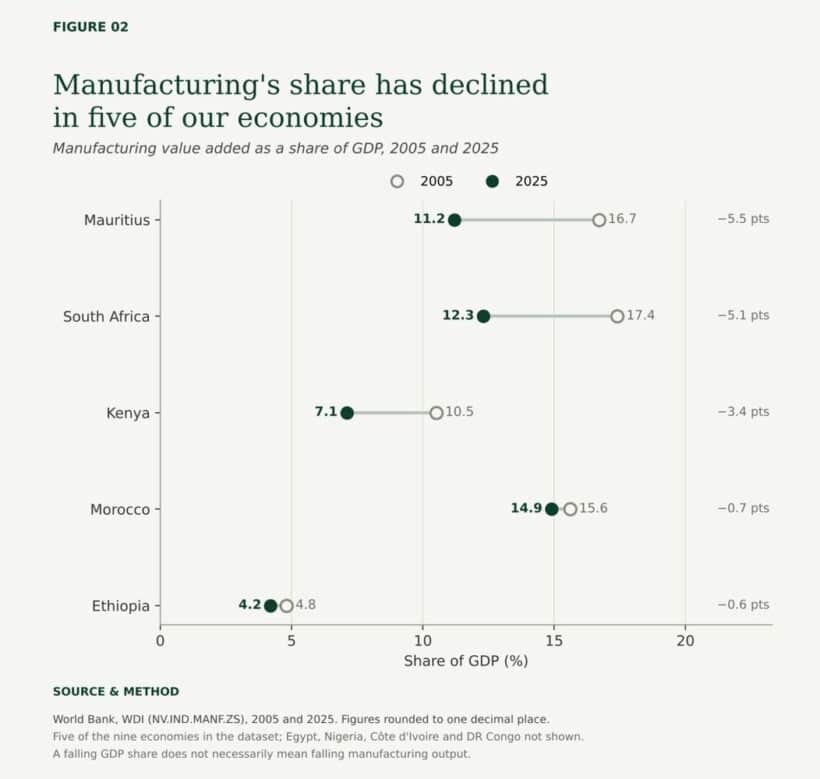
The country experiences deserve different readings. Mauritius must consider how industrial upgrading can advance alongside an increasingly service-oriented economy. South Africa’s task includes renewing established industrial capabilities amid infrastructure and energy constraints. Morocco’s integration into international manufacturing networks raises the question of how far supplier development, engineering and technological learning extend into the domestic economy. Ethiopia’s industrial ambitions depend on the practical economics of factory utilisation, foreign exchange, logistics, reliable energy and access to markets. The same indicator opens four different inquiries; it does not deliver one prescription.
From corridors of movement to territories of production
I have come to see ports and corridors as a particularly revealing test of economic architecture. A port can move more containers, a road can reduce journey times and a railway can carry more tonnes, yet the decisive question remains: what productive activity becomes possible because those connections exist? Connectivity shapes where firms locate, which inputs they can source, the markets they can serve and the reliability with which they can compete. The measure of a corridor’s success should therefore extend beyond cargo movement to the productive territories it helps develop.
Imagine two maritime gateways with similar operational performance. One is principally a channel through which imports and exports pass. The other is closely connected to industrial estates, agricultural processing centres, domestic suppliers, inland cities and commercial distribution. Both perform an essential logistical function. The second is positioned to support a wider network of enterprise, skills and reinvestment. This distinction matters in the Indian Ocean, along the Atlantic coast and across the inland corridors linking African production centres to ports and markets.
Advertisement
The same reasoning applies to mineral corridors. Moving ore efficiently is valuable. Building domestic engineering services, processing capacity, reliable industrial energy and specialised supplier firms around the corridor can multiply the economic effect. That is a demanding task. It requires commercial discipline and realistic assessments of scale, technology, markets and comparative advantage, rather than assuming that every resource should be processed through every stage locally.
Energy must be understood as a complete productive system. Electricity matters, but so do industrial heat, fuels, generation and transmission reliability, affordability, security of supply and the logistics of energy inputs. A factory connected to a grid yet exposed to repeated interruptions or prohibitively expensive power may struggle to compete. A transport network that moves freight but lacks dependable fuel and maintenance systems is similarly constrained.
The opportunity is to organise these investments as a coherent economic system. Industrial estates need credible cargo flows and customers; transport links need productive demand; energy projects need industrial users able to pay; skills programmes need enterprises with real vacancies and growth prospects. Their sequencing matters as much as their individual design. An impressive collection of projects is not automatically a functioning productive economy.
Capital is an input. Employment is a transmission mechanism
Investment provides the means for transformation, but its aggregate volume tells us little about the productive relationships it creates. Fixed capital formation can finance homes, roads, ports, factories, mines or machinery. Those assets differ in the jobs they support, the capabilities they require and the domestic suppliers they engage. To understand the prosperity dividend, we must follow capital beyond the announcement and into the enterprises, skills and markets it helps establish.
Our third figure compares gross fixed capital formation with wage-and-salaried employment across seven African economies in 2025. Mauritius, Côte d’Ivoire and Ethiopia each recorded fixed investment near 20% of GDP in the rounded comparison. Yet wage-and-salaried workers represented approximately 82.2%, 29.0% and 15.7% of their respective employment totals. South Africa combined a lower investment share, around 14%, with a wage-employment share of 82.7%. The Democratic Republic of Congo showed an investment share near 29% but wage employment of 14.9%.
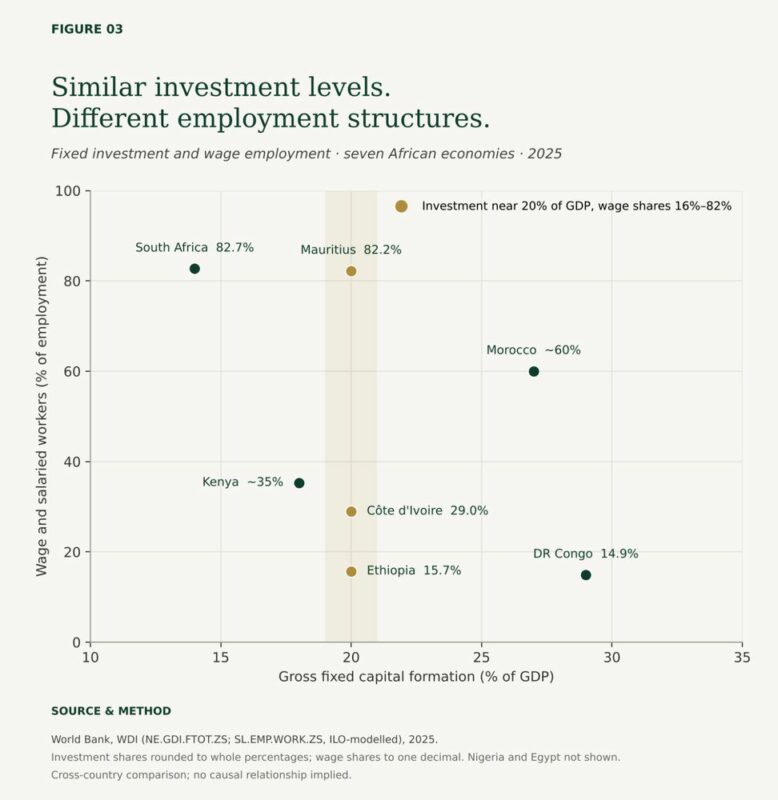
These differences are striking, but they are not a causal test. Today’s employment structure reflects decades of economic development, demographics, institutions, urbanisation and sectoral composition. A single year’s investment ratio cannot explain it. Nor is wage employment a complete measure of job quality: pay, security, productivity and working conditions matter, and own-account enterprises can be productive and innovative.
Advertisement
This is the distinction I want the investment debate to confront. Mobilising capital is an achievement; building an economy in which more people can earn a secure and productive living is another. The bridge between them is constructed through competitive enterprises, local procurement, technical capability, functioning markets and institutions that allow investment to mature into sustained production. Neither a high investment ratio nor a high wage-employment share, taken alone, can tell the whole story.
The institutions that connect growth to prosperity
Economic architecture is institutional as well as physical. It is expressed in the everyday capacity to make a permit predictable, a port reliable, an industrial site usable, a training programme relevant and a financing decision commercially sound. These may appear to be separate administrative questions. For an enterprise deciding whether to invest, expand or export, they form one operating environment.
Four connections are especially consequential. Infrastructure must connect to enterprises, so that improved throughput and travel times translate into competitive production and market access. Education and training must respond to evolving industrial demand while preserving the wider value of learning. Finance must meet credible business models, sound governance, technical competence and routes to customers. Public revenue must strengthen productive public goods, from dependable services to maintenance and institutional capability. Each connection is a point at which economic momentum can either compound or dissipate.
These connections require measurement. Port volumes should be read alongside inland logistics costs and the growth of productive enterprises. Industrial investment should be assessed with factory utilisation, export performance, supplier development and employment quality. Energy capacity should be examined with delivered reliability and industrial affordability. Headline investment announcements are starting points for evaluation, not substitutes for it.
This work calls for capable public institutions and ambitious private enterprise, each performing a distinct function. Governments set credible rules, invest in public goods and coordinate where markets alone cannot. Firms identify demand, innovate, organise production and take commercial risks. Investors allocate capital; educational institutions develop knowledge; workers and entrepreneurs turn opportunity into capability. What matters is the quality of their interaction, not the prominence of any one actor.
A different test of economic success
I would judge economic progress with three questions alongside the GDP growth rate. What can this economy now produce that it could not produce before? How broadly are those capabilities reflected in stronger enterprises, better work and rising household incomes? And how much of the value created remains available for domestic reinvestment and future production? These are questions of economic capability, participation and retention. Together they offer a more demanding test of prosperity.
These questions resist easy answers. A country may register impressive growth while its domestic supplier base remains thin. Another may achieve rapid gains in exports without comparable gains in formal employment. A third may see manufacturing’s GDP share fall while its manufacturing output and productivity continue to rise. Good analysis must distinguish these outcomes rather than compress them into a single verdict.
For governments, this calls for coherence among industrial strategy, trade policy, infrastructure, energy, finance and human capital. For investors, it means examining the commercial ecosystem that will sustain an asset after construction. For enterprises, it means building standards, skills, scale and market relationships that endure beyond one contract or commodity cycle. For corridor and port authorities, it means understanding the economy behind the cargo as carefully as the cargo itself.
Africa’s economic future will be shaped by what its cities, productive territories, enterprises and people become capable of building together. Growth creates momentum. Capital makes new possibilities available. The decisive work is to convert both into productive organisations, better livelihoods and wealth that can be retained, reinvested and passed forward. That is the measure I return to when looking at a port, an industrial project or a trade corridor: not only what moves today, but what can flourish there tomorrow.
SaveShare